A few years ago, I probably wouldn’t have written this blog. Actually, that’s not true. Twenty-five years ago, I definitely wouldn’t have written it.
Early in my corporate career, I picked up a copy of Meditation for Dummies. At the time, my interest in meditation had very little to do with leadership. I was exploring it as a tool for my personal life and, if I’m being completely transparent, hoping to manifest some of the things I dreamed about—the husband, the beautiful home, the perfect family, the life I imagined for myself.
I achieved much of that, by the way!
What I didn’t realize when I picked up that book was that meditation would eventually become one of the most valuable tools in my leadership toolbox. Not because it magically created the life or career I wanted, but because over time, it helped me quiet the noise, become more self-aware, trust myself, and feel more connected to what I know to be true.
Today, as an executive coach, I see just how much leaders need that kind of space.
So many of the leaders I work with are smart, capable, successful high achievers who are managing a lot. Their minds are still running long after the workday ends. They’re thinking about the meeting that didn’t go well, tomorrow’s presentation, the difficult conversation they need to have, the organizational change coming around the corner, and the 47 other things on their list. They have trouble turning it off at night, transitioning from work to home, and creating boundaries between all the different parts of their lives.
I often describe it as living on the hamster wheel.
For years, I’ve talked about helping leaders get off that wheel so they can become more intentional about their choices and how they show up. But lately, I’ve been thinking there may be an opportunity to go a little further.
What if leadership isn’t only about becoming more intentional? What if it’s also about becoming more aligned?
And this is where things might get a little “woo woo.”
Many of us learned how to compartmentalize as we moved through our careers. I certainly did. Work went in one box. Family went in another. Stress, fears, dreams, relationships—they all had their own boxes too. We became incredibly skilled at packaging things up, putting them on the appropriate shelf, and opening whichever box the situation required.
In my corporate leadership years, that served me well. I followed the rules, worked hard, delivered results, and did what needed to be done. I always had a thread of care, concern, and heart running through my leadership, but I was still separating parts of myself rather than considering how all those pieces fit together.
Over time, that began to change. I became more intentional about how I showed up and more attuned to the people around me. In the workplace, we called some of that emotional intelligence and empathy. Later, I described it in my book as “leading with heart” and being intentional in how you show up.
Today, I think I would describe it a little differently.
I would call it aligned leadership.
Aligned leadership is what happens when your values, intuition, actions, energy, and intentions begin working together rather than competing for your attention. You aren’t leaving parts of yourself at the door when you walk into work because, really, none of us do. We are one whole human being showing up every day to interact, connect, influence, impact, and lead other whole human beings.
When you begin leading from that place, something shifts.
I have a coaching client who is incredibly open to growth. He rarely comes into our conversations with a perfectly packaged coaching topic. Instead, he brings whatever is occupying his mental real estate at that moment—a relationship, an anticipated conflict, a challenge, or something he can’t quite stop thinking about.
Our conversations are fluid. We explore what’s happening, look at it from different perspectives, and consider how he wants to show up. And then, inevitably, the thing we’ve been talking about seems to appear in his work.
Sometimes within days. Recently, it happened within an hour of our coaching conversation.
We joke about these moments, and he calls them coincidences. He would also really like us to spend more coaching time talking about his college football team so he can speak another national championship into existence. 😂
But I’ve come to believe there are very few coincidences. Maybe there are more coordinated incidents.
When something occupies our thoughts, attention, and energy, we become more aware of the opportunities, patterns, people, and circumstances connected to it. We notice things we might have missed before. We’re more prepared when the situation arrives, and because we’ve created space to consider our intentions, we can respond differently when it does.
Is that “woo woo”? Maybe.
But it’s also incredibly practical leadership.
Leadership is fundamentally about awareness, and that awareness has to start with ourselves. The most effective leaders don’t just understand business metrics, market conditions, and organizational challenges. They understand what’s happening inside themselves, too. They recognize when they’re operating from fear instead of confidence, reacting instead of responding, or forcing an outcome instead of creating enough space for clarity to emerge.
Meditation has helped me create that space, but meditation isn’t the only answer. I have clients who use apps like Headspace, while others insist they “aren’t good at meditating” because they can’t turn their brains off. My response is always that the goal isn’t necessarily to turn your brain off.
Find what works for you.
Maybe it’s exercise, a long walk, time in nature, prayer, journaling, or even a walking meditation. Maybe it’s simply ten quiet minutes before everyone else wakes up. The practice matters less than your willingness to create enough space to hear yourself again.
Because beneath all the business buzzwords we use—resilience, agility, adaptability, change leadership—there is something much more human: connection.
Connection to yourself. Connection to your purpose. Connection to the people you lead.
My own journey to understand this has been decades in the making. From watching Oprah as a teenager in the '80s, to Tony Robbins, Brendon Burchard, Abraham Hicks, Gabby Bernstein, and so many others along the way, I’ve absorbed ideas and inspiration that have ultimately helped me arrive at my own sense of what I know to be true.
And today, that feels grounding. Calm. Confident. Connected. There is less forcing and more knowing.
Maybe that sounds “woo woo” to some people. I’m okay with that.
Because I’m beginning to think the leaders we need for the future aren’t those who get better at compartmentalizing, pushing harder, or running faster on the hamster wheel. We need leaders who are deeply connected to themselves so they can more authentically connect with others. Leaders who create space to listen, notice, trust, and choose. Leaders who bring their whole selves to the responsibility of leading other human beings.
Perhaps that is the next evolution of intentional leadership.
A little less forcing. A little more alignment. And yes, maybe even a little more “woo woo.”
If you’re ready to get off the hamster wheel and explore what greater intention and alignment could look like in your own leadership, let’s connect. Sometimes the most powerful shift starts by simply creating enough space to hear what’s already there.
There’s something about the summer-time—longer days, summer vacations, and a subtle shift in pace—that creates space to step back and reconnect with what matters most. It’s a season that invites more connection, especially with the people we love. For many of us, that means more time with family. And if you’re anything like me, you’ve likely noticed that as your kids get older, that time together doesn’t happen as naturally as it once did.
Everyone has their own plans, their own interests, their own version of fun. And while that independence is something to celebrate, it also means that creating meaningful family moments requires a bit more intention than it used to.
That’s where something we call forced family fun comes in.
In our family, forced family fun isn’t about obligation—it’s about intention. It’s about creating moments that wouldn’t happen otherwise unless we made the effort. Sometimes it’s something simple, like a night at the pool hall followed by sushi. Other times, it’s planning a long weekend or a short getaway.
This year, my family took advantage of the Fourth of July falling on a long weekend and headed out to Colorado together. No friends invited, no splitting off into different directions—just time for us to reconnect as a family. While it may have started with a little resistance due to competing plans and a few questions about why we have to do this, it didn't end that way. What we’re really doing is creating space for connection and once we’re in it—laughing, sharing stories, being present—that initial resistance fades, and what’s left is something much more meaningful.
That idea—of intentionally creating connection—has been sitting with me lately, not just in my personal life, but in the work I do with leaders and teams.
I believe this same dynamic is playing out in the workplace.
The way we work has changed dramatically over the past few years. Hybrid and remote models have created flexibility and autonomy, which many employees value, but they’ve also introduced a new challenge—one that isn’t always immediately visible.
Connection no longer happens organically the way it used to.
And it's not just because people are working remotely. Even in organizations where employees are physically together, many spend their days moving from one back-to-back meeting to the next, often joining virtually from behind their own desks. Increasing workloads, competing priorities, and the constant pressure to keep up can leave little time for anything beyond heads-down execution.
As a result, the informal conversations, spontaneous brainstorming, and moments of shared laughter between meetings—those small, everyday interactions that quietly build trust and relationships—have become far less frequent. In their place, we have more structured communication, more scheduled meetings, more transactional exchanges. And while work is still getting done, something is missing.
Leaders are feeling it in the form of lower engagement, slower alignment, and teams that don’t quite feel as connected as they once did. It’s not that people don’t want connection. It’s that connection doesn’t just happen anymore. It has to be created.
That’s why so many organizations are investing in bringing their people together again.
In fact, according to a recent Korn Ferry commentary on workplace trends, nearly all companies are now hosting off-site events—far more than before the pandemic. At first glance, this might seem surprising, especially in a time when employees value flexibility and autonomy. But when you look a little deeper, it makes perfect sense. Organizations are trying to rebuild something that used to happen naturally—connection, trust, and a shared sense of purpose. In many ways, these off-sites are the workplace version of “forced family fun”. They are intentional moments designed to bring people together, even when it might feel inconvenient or unnecessary at first.
And just like at home, not everyone shows up fully on board. Some employees question the value. Others feel the tension of stepping away from their workload or personal responsibilities. There can be a quiet sense of skepticism—this better be worth it.
Over the course of my corporate career and now in my work with leadership teams, I’ve seen both sides of this.
I’ve experienced off-sites that felt like a nice break from the routine but didn’t create any lasting impact. People connected on the surface, enjoyed the experience, and then returned to work exactly as they were before. I’ve also been part of gatherings that were truly transformative. The difference wasn’t the location, budget, or even the agenda, it was the intention behind it.
When leaders are clear about the purpose of bringing people together—whether it’s to build trust, align on strategy, or create space for honest conversation—the experience shifts. It becomes more than just time away from the office. It becomes a catalyst. Trust, alignment, and connection aren’t built through email threads or status updates. They’re built through shared experiences, meaningful dialogue, and moments where people feel seen and heard. Those outcomes may not show up neatly in a spreadsheet, but they show up everywhere else.
In how quickly teams make decisions.
In how openly people communicate.
In how willing individuals are to support one another and move forward together.
What I find most interesting is how closely this mirrors what happens in our personal lives.
At home, we can’t assume connection will happen as our lives get busier and more complex. We have to create it. We have to make the time, even when it’s not the easiest option. And the same is true in leadership.
We can’t rely on connection to happen organically in today’s work environment. We have to be intentional about creating opportunities for it.
That doesn’t mean every team needs a large-scale off-site. It might be a smaller gathering, a team dinner, or even a well-designed working session that prioritizes meaningful interaction over just getting through an agenda. What matters most is the clarity of purpose.
Why are we bringing people together?
What do we want them to walk away with?
How will this experience help them show up differently afterward?
When those questions are answered with intention, the return becomes clear.
As you move through the summer, I invite you to think about where you might need to create more intentional space for connection. Maybe it’s with your family—planning that trip or that evening together that might not happen otherwise. Maybe it’s with your team—bringing people together in a way that goes beyond the transactional and into something more meaningful. The moments that feel a little forced at first … are often the ones that matter the most.
If you’re thinking about how to create more meaningful connection within your team or leadership group, I’d love to support you. Whether it’s designing an intentional off-site, strengthening alignment, or building trust in a more hybrid world, let’s start a conversation.
Reach out and let’s explore how you can create moments that truly make an impact—for your team and for yourself.
As we turn the page into 2026, I’ve been reflecting on the conversations I’ve had with leaders this past year, from executives navigating AI expansion, to high-potential talent building confidence, to teams trying to transform how they work together.
One thing is clear:
2025 changed us.
It reshaped expectations. It stretched our capacity. It asked us to step into leadership with more intention, more courage, and more humanity than ever before.
And the leaders who rose to the moment—the ones who inspired connection, sparked possibility, and created meaningful impact—shared something in common.
They didn’t wait for clarity…
They created it.
They didn’t chase perfection…
They led with heart.
As we step into 2026, here are the five leadership essentials I believe every leader will need to navigate the year ahead with confidence, courage, and clarity.
If 2025 taught us anything, it’s that change is no longer an event—it’s a constant. AI, restructuring, new operating models, evolving customer expectations… the pace isn’t slowing down.
But here’s the real truth leaders can’t ignore:
Change doesn’t fail because of strategy. It fails because of people.
This year, I watched leadership teams thrive when they paused long enough to ask:
How will this change impact our people? What will they fear, hope, or wonder? What do they need from us to feel supported and informed?
Leading change in 2026 means focusing on alignment, communication, clarity, and emotional connection—not just systems and tools. The leaders who embrace the human side of transformation will be the ones who sustain momentum long after the excitement of the plan fades.
I said it all year long because it kept proving true:
Intentional leaders create the greatest ripple of impact.
Whether you’re rolling out new technology, preparing your team for a big initiative, or simply navigating the everyday pressures of leadership, intention is the difference between:
Your leadership presence matters.
Your tone matters.
How you show up—especially in moments of pressure—matters.
Going into 2026, ask yourself regularly:
What does this moment need from me?
What outcome do I want to create—emotionally, relationally, and operationally?
How can I model the mindset I want others to carry?
Intention is not a skill you master once. It’s a daily practice. And it’s one of the most powerful tools you have.
So many leaders I coach struggle with confidence—even those who seem most put together on the outside. I get it. I spent too many years in corporate honoring my own inner critic.
But here’s the shift I want every leader to make in 2026:
Confidence isn’t about knowing all the answers.
It’s about trusting your ability to figure things out.
Real confidence is built through self-awareness, preparation, and the steady belief that you can navigate whatever comes your way. It’s strengthened when you speak to yourself with more compassion, set boundaries that protect your energy, and take steps forward even when you’re not 100% sure how things will unfold.
It grows from acknowledging your competence, owning your strengths, and trusting that—even in moments of uncertainty—you will rise to meet the moment.
Doubt will whisper. It always does.
But your confidence will grow strongest when you decide to show up anyway, anchored in the belief that you are capable, adaptable, and resourceful.
This year, leaders everywhere learned to navigate the tension between efficiency and empathy. AI accelerated work, elevated expectations, and reshaped roles. But it also highlighted something important:
People still crave what only leaders can give—connection, trust, safety, and belonging.
As workplaces evolve even more in 2026, here’s what your people will need from you:
Yes, AI will continue to expand, but so will the need for human leadership—leaders who understand that culture is built in moments, not memos.
That starts with you.
Whether I was facilitating leadership offsites or guiding teams through transformation this year, one theme kept surfacing:
Collaboration isn’t a “nice to have.” It’s a strategic advantage.
Silos slow organizations down.
Misalignment creates friction.
Lack of clarity drains energy, trust, and execution.
In 2026, the most effective leaders will be the ones who:
One of my favorite leadership moments this year was hearing a technology leader use the word collectively seven times in a single kickoff.
That’s the mindset 2026 demands.
Not just leading independently…
But leading collectively.
If 2025 was the year of expansion, then 2026 will be the year of integration—blending technology with humanity, urgency with empathy, and strategy with intention.
Leadership is changing.
Expectations are rising.
But so is your capacity.
You’re not leading in spite of the change—you’re leading because you’re uniquely equipped to make sense of it, humanize it, and guide others through it.
Lead with intention.
Lead with connection.
Lead with heart. 💜
If you’re ready to step into 2026 with clarity and renewed confidence, I’d love to partner with you. Let’s explore how coaching can help you elevate your impact and lead the way—with purpose, courage, and heart.
You don’t have to lead alone.
Let’s make 2026 your most meaningful leadership year yet.
When I work with leaders, our conversations often start with the whirlwind of today—the challenges they’re navigating, the pressure to deliver, the teams they’re managing, and the strategies they’re refining. And understandably so. There’s a lot coming at leaders right now.
But one of the most important roles I play as a coach is to help them lift their gaze beyond today’s fire drills. To pause the urgency just long enough to ask: Where are you going? And are you building the team, the function, and the strong relationships today that will support that future?
In today’s complex, fast-moving environment, strong relationships are no longer a nice-to-have. They’re a differentiator. A strategy. A lifeline. And they’re often what separates leaders who thrive in ambiguity from those who feel stuck in it.
We often think of leadership in terms of output—decisions made, goals hit, change managed. But beneath every major achievement is a network of relationships that either helped get it done or made it harder.
Years ago, I heard someone describe relationships at work like a bank account. You make deposits by showing up, following through, being helpful, building trust. And yes, you make withdrawals—especially when things go sideways, the stakes are high, or you need support.
That metaphor stuck with me throughout my corporate career—especially in my operational roles where I was constantly supporting sales and execution. I knew that in times of high pressure, I’d need to rely on others. And if I hadn’t made enough deposits? Those asks would come up short.
I called them “chits.” You never want to be in a storm with no chits in the bank.
Building strong relationships used to be something that happened over time—through projects, hallway chats, shared experiences. But let’s be real: the world of work looks very different today. Hybrid environments, heavier workloads, and increasingly matrixed organizations mean that relationships don’t build themselves anymore.
In fact, they often get de-prioritized.
That’s a mistake.
Because the complexity we’re navigating today means our relational bank accounts are being depleted faster than ever. The volume of change, the demand for cross-functional collaboration, and the sheer speed of decision-making require a new level of relationship equity.
So instead of hoping relationships will form organically, I encourage leaders to be intentional about building them—strategically, proactively, and authentically.
Let’s talk about how relationships are built today. In my coaching conversations, I’ve found that strong, strategic relationships form in three main areas:
One challenge I hear often from leaders is that building relationships feels awkward. Do I just randomly set up a coffee chat with someone? Won’t that seem strange?
Maybe. But when done with intention, it doesn’t have to.
Start with those you already collaborate with. Set up brief check-ins that include space for more than just status updates. Ask how you can support their priorities. Use your existing network—your inner circle—to help connect you with others.
Think of it like networking, but within your own organization.
As Korn Ferry recently shared in their article, "5 Ways to Be Sure Your Boss Sees Your Good Work“, many professionals feel uncomfortable promoting themselves or asking others to advocate for them. But enrolling your close-in circle in your success is not self-serving—it’s strategic. And it’s part of building that bank account.
If you’ve built trust with someone, let them know what you’re working toward. Ask if they’d be willing to share your contributions, advocate for your work, or make introductions to help expand your impact. You’re not asking for favors—you’re cultivating relationship equity.
Final Thought:
The complexity of leadership isn’t going away. If anything, it’s increasing. But your relationships—your leadership bank account—can be your most powerful asset.
Be intentional. Build early. And remember: the leaders who thrive in today’s world aren’t just managing tasks—they’re nurturing connection.
Let’s build something together.
If you're looking to elevate your leadership impact by strengthening your relationships and influence across your organization, I’d love to connect.
Connection is the currency of leadership.
And it compounds over time—sometimes in ways you don’t even see until someone reminds you, years later, that you made a difference.
A few weeks ago, I received an unexpected message.
In it was a link to an article, along with a short note that simply said, “I read this and thought of you.”
It was a Forbes article, “The Hidden Cost of Remote Work: Lost Rituals and Human Moments”. It explores how the informal rituals we once took for granted—like walking to the parking lot together after a long day, catching up at the coffee machine, or pausing for a birthday celebration—have faded in the modern workplace.
These rituals might seem small, but they held meaning. They built connection. And they made work feel human.
As I read, I was nodding along. This message was so aligned with everything I believe—and everything I strive to help leaders embrace. Meaningful leadership doesn’t happen by accident. It happens through small, intentional acts that build trust, spark belonging, and make people feel seen.
Sometimes, those moments come full circle.
In leadership, we often think of legacy as something we leave behind. A title. A project. A metric of success. But legacy is also how you make people feel.
If you’ve followed me for a while, you’ve heard me say:
Legacy isn’t someday. It’s every day.
It’s not about a title or a milestone. It is about how you lead right now.
The way you listen
The tone you set
The care you bring to each interaction.
We live in a fast paced world, one where many of us work remotely or hybrid, and it can be easy to default to tasks over connection. But leadership isn’t just about getting things done. It’s about how people experience you along the way.
Too often, you don’t know you’re leaving that kind of legacy until much later. That’s why I believe so deeply in showing up with intention every day, especially in the smallest of ways—because those small moments are the true currency of leadership.
The rituals of work might look different now, but that doesn’t mean that connection is gone. It just means we need to be more intentional about how we create it.
Think about your own team. Are there routines or touch points that used to create a sense of belonging? Can you reinvent them?
Here are a few practical ways to bring more meaning and connection into the everyday:
Meaningful leadership happens in all these moments. These small acts build trust, deepen connection, and remind people that they matter. They are, in fact, the currency of leadership.
The article wasn’t just powerful because of its message. What made it truly special was who sent it.
It came from someone I worked with over 20 years ago. Back then, she was on my team and I enjoyed supporting her in her career interests and goals. We had a strong connection through the shared grind and growth of corporate life, and while our paths diverged over the years, we’ve stayed loosely in touch.
She recently shared with me that I had made a lasting impact on her career—and what I probably never said enough is that she also made an impact on me.
So when she sent that article—when she thought of me in the context of a piece about meaningful leadership and human moments—it truly meant something.
It was a reminder that the small ways we show up, care, connect, and lead can ripple out in ways we don’t always see. Sometimes, years later, they come back around and remind you that you made a difference.
So, thank you, Jane. For the article. For the connection. And for reminding me that legacy lives in the everyday moments.
Curious how your leadership is experienced by others? Take the Heart Leader Assessment to discover your heart score and learn how to lead more meaningfully and intentionally today.
Or book time with me to explore how we can help your team create more human moments in a hybrid world.
Let’s connect.
As we step into the year 2023, corporate leaders are faced with an ongoing challenge of a rapidly changing business environment. For a few of my clients, I am seeing them face a very pressing and unfortunate issue - navigating the challenge of layoffs. This has created a sense of uncertainty and fear among employees and highlighted the importance for them to navigate - purposefully, transparently, and with care and compassion.
Recently, I observed one of my executive clients communicate a very difficult message to his team that 50 jobs would be eliminated. Each one of the employees in the room was directly impacted. He delivered the news clearly yet compassionately as he explained the circumstances, acknowledged the impact of the decision, and offered space & uncomfortable silence for the individuals sitting in front of him to process the news best.
He put himself in the shoes of his employees - many tenured and committed for years to the organization - and took a heart-centered approach to share the difficult news. In navigating the challenge of layoffs, he met his employees in a place of empathy, went off script a little where necessary, and did his best to hold the space they needed to receive the news. He showed up as an intentional leader during a difficult time, and his actions served as an excellent example for other executives to follow.
In my book, Lead with Heart & Leave a Legacy, I talk about my own experience as a corporate executive faced with communicating a layoff. The lack of progress against the company strategy led to a top-down decision to execute a reduction in the workforce across the organization.
It was a heartbreaking day, but my team needed a sincere, transparent, vulnerable leader. The experience taught me the importance of leading with care and compassion during difficult times and proved to be the best approach in minimizing impact on the people.
When navigating the challenge of layoffs, intentional leaders prioritize taking steps to minimize the impact on their employees. They do this by adopting a heart-led approach that focuses on transparency, compassion, and being connected.
Here are three things that intentional leaders do when navigating the challenge of layoffs:
For my executive client, how he chose to communicate the devastating news influenced how those individuals reacted and accelerated their ability to process through the change. While life-changing, they felt supported and mirrored their leader's calm sense of commitment.
The year 2023 will continue to present many challenges for corporate leaders, including the ongoing issue of layoffs. By communicating transparently, showing care and compassion, and being mindful of the concerns of their remaining employees, corporate leaders can navigate the challenge of layoffs while minimizing employee impact and fostering a culture that will thrive in the years to come.
If you are a corporate leader looking to develop intentional leadership skills in your organization and cultivate a culture of care and compassion even in the most challenging of times, I invite you to work with me.
I recently read a statistic: only 50% of businesses are still operating after 5 years. So, I quickly did some math and discovered that I established my LLC and took my first client after leaving the corporate world in 2017. Looks like I’m officially five years in – I made it!
My passion for leadership development began in my work at Catalina, and after some life-changing events, I left 70-hour work weeks to follow that passion. I knew I wanted more autonomy, flexibility, and fulfillment, and I wanted to make an even bigger impact. I wanted to take my experience and share it with other grow-minded leaders. So I started my company, named White Cap Coaching with inspiration from my kids (representing the things we love to do as a family – be on the water and in the mountains) and grew it from the ground up.
The topic of leadership resonated with me so much I wrote an entire book about it – Lead with Heart & Leave a Legacy.

And over the past 5 years, I’ve led my company through multiple evolutions. I’ve refined my messaging, impact, and moved from what I knew – traditional corporate speak (the male CEOs I worked with and for over the years taught me well!) – to a more authentic, relatable and intentional message. Now, my messaging matches my experiences and, most importantly, the unique and meaningful value and service that only I can provide to my amazing clients.

I cannot believe it has been 5 years already! I have connected with so many wonderful, intentional leaders and learned so much from them, and I’ve practiced specific strategies for success to help me stay focused and set me up for success.
As a solopreneur with a mission to support leaders as they define their own legacy of leadership for a happy, successful, and fulfilling life and career, I’ve learned quite a few things along the way. And today, I’d love to share the 5 keys to business that I’ve unlocked at this point in my business.
In the early days, I was caught in the trap of looking at others who were further along their path. I thought if I emulated what I saw them doing, it would accelerate my success.
But the truth is that comparing yourself to others knocks you off track from your true purpose. Comparison is the fastest way to forget the reason you started your business to begin with.
For me, it was to help leaders find simplicity in the complex and to be in service to them to find fulfillment, meaning & impact in their roles as leaders and in their lives as beautiful, whole people. Comparison can be evil. I learned that the faster path to success happened when I wasn’t worried about what others thought, or how others perceive me. I learned to practice finding inspiration in others’ successes while staying aligned to the path I was on without any apology for it.
I quickly realized that if I spent too much time trying to perfect what I was working on, I would never move forward. My business has changed in mind blowing ways since it began.
Over the years, I’ve changed my:
Trying to perfect everything was a distraction from the true work I needed to do. Instead of creating something perfect, stay in motion and keep moving forward – refining and improving as you go.
Starting your own business, especially as a solopreneur, requires a lot. The path will never be easy, but it can involve more ease.
I was working 70 hours a week in the corporate world, and I easily carried that bad habit into my new business at first. But I had to remind myself that I started this business to be different, to enjoy my work, to have more time and freedom.
Starting your own business isn’t easy but there should be some ease associated. Once I figured out how to stay in flow and connected to the work that I was doing and the impact I was making, I felt a lot more ease. It was also important that I operated in alignment, modeling what I was teaching my clients in my own work and business.
Intention is a huge reason my business has thrived for five years! In my work, intention shows up in every aspect of what I do:
Showing up with intention helps me stay in alignment, be flexible with my work, and know when to pivot.
This month as I celebrate my 5 years in business, I am privileged to gather with clients, colleagues, and friends to celebrate this accomplishment and thank those who supported me along the way.
The journey has not always been easy, there have been many ups and downs (including a significant health scare!) but starting my own business and following my passion has been one of the biggest wins of all. Over the past 5 years, whenever work became stressful and busy or something did not go my way, I often forgot to count the wins.
But celebrating even the small wins matters. All of those tiny victories have contributed to my overall success – helping me become a better leader and entrepreneur.
I started my business journey investing 25 years in the same company, learning 7 leadership lessons.
And now 5 years into my business as a solopreneur, I’m sharing the 5 keys to business I’ve discovered so far.
These milestones are the perfect opportunity to reflect on my experience and share all I’ve learned.
I’m endlessly grateful for the people I’ve met, the leaders I’ve coached, the lives I’ve changed, and the business I’ve created. Cheers to the next five years as a small business owner!
I have a unique vantage point to the impact of this global pandemic. As a coach, I have had the privilege to support a number of clients as they maneuver through these unchartered waters.
From the manufacturing company who has an emerging growth opportunity from the epidemic and is struggling to keep up with demand, to the hospitality client who furloughed the majority of their corporate staff, to the local small business that had to close their doors after 25 years, to the national nonprofit who turned on a dime to focus all their own resources to helping other nonprofits simply try to survive.
While these organizations are all distinctive sizes, industries, communities and all impacted very differently by this unexpected crisis, there is one thing they have in common.
The most empathetic, heart-centered and ultimately effective leadership is being demonstrated most often among their front-line leaders.
Those managers and directors who are out in front – interacting daily with the employees executing the work and supporting the customer - are the ones showing the care, compassion & connection that is so critical right now.
According to a new report from NordVPN, the average workday in the US has increased by almost 40% since mid-March...that’s an extra 3 hours per day! Shelter-in-place orders have forced work from home and people are starting their days earlier and ending at the same time or even later. The boundaries between home life and work life are blurred and to make matters worse, the challenges associated with minimizing environmental distractions, zoom fatigue, and homeschooling guilt has the average employee experiencing a 10-20% reduction in productivity on any given day.
Job satisfaction is decreasing, stress levels are increasing, and work environments are emotionally charged. Not surprising given all that we are taking in and experiencing 24/7 around this global pandemic.
Higher up in the organization, the tendency seems to be to lead with a heavy hand – directive approach, quick reaction, the crossing of boundaries, lack of empathy – and worse yet, not leading at all and missing opportunities to communicate hope for a brighter tomorrow.
Where I see leaders with fundamental awareness and authentic appreciation for the emotional and physical toll that social distancing and shelter-at-home is taking, is where I see the greatest stories of connected and intentional leadership.
It is the customer service manager, the digital director, the senior account manager who are interacting daily with front-line employees in the work that is most in tune and taking the approach most necessary - people 1st, company 2nd, self 3rd.
These are some great examples of intentional leadership.
There is one more important thing you can be doing to engage employees and help them with a sustainable performance mindset through this difficult time? Ask one important question...
Being a cheerleader, encouraging fun, and spreading positivity is nice, but can be short-lived. In answering the question of unexpected blessings, we are moved to a mindset of gratitude which is much more sustaining and can appropriately help your people focused forward toward better days.
Through my work, I have curated some intentional practices of what’s working well for leaders in leading their teams remotely through this uncertain time ==>
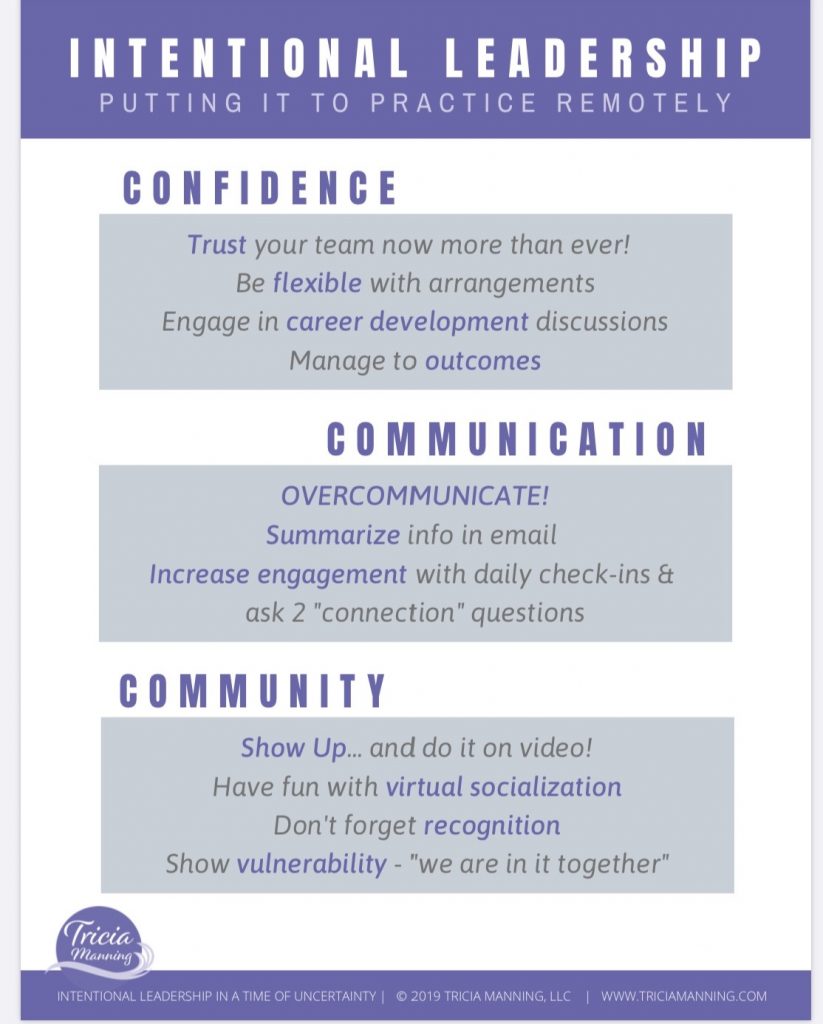
Think about how you are putting these strategies into practice with your teams. And for more details & examples around these strategies or help with additional ideas on to how to best support your teams, reach out to me directly. I would love to help.
Virtual HIGH FIVE to those front-line leaders who are committed to intentionally engaging the hearts and minds of their people, especially right now when it is needed most 💜

The last few months have been a true awakening and forced us to recognize what is most important in our lives.
Similar to the personal health crisis I faced a few short years ago, for all of us, this global health crisis is bringing our priorities into focus - health, family, relationships, time, happiness; and creating an inventory of what we need to be strong and prepared to continue to push through.
This defining moment in history and in our lives has made us more aware of what changes are needed.
Let’s face it…many of us have spent a good part of our lives waiting for the inspiration to do something different, to make a bold change. This world crisis is a defining moment and it is accelerating the shift.
Do you want more meaning and inspiration in your life and career?
Now is the best time to take yourself out of what you do, the job you are in, the path you are on, the success you are tied to, and focus on the things that inspire you and that give you energy. It is up to you to create your own inspiration.
This doesn’t mean that you have to walk into the boss’ office tomorrow and quit, abandon your current business or make a complete career transition.
If you want to make a change but don’t know where to start, don’t know what you really want, or are fearful of leaving old measures of success behind, there are a few things you can do to take control and take the first steps:
You have options and there is no better time to define your success on your own terms, achieve it by your own rules, and build a life you're PROUD AND INSPIRED to live...

If you are feeling ready to face your fears and take the first brave step forward toward a more meaningful and fulfilling life and career, please join my next zoom webinar on June 9: Redefining Success: The First Steps Toward Change. I will share more detail on how you can take back control and introduce you to the 8 Steps in creating a one-of-a-kind Heart-centered Women's Blueprint to re-engineer all aspects of your life and increase confidence and satisfaction in your career & your next great chapter overall.
ABOUT THE AUTHOR:
Engaged and inspired by smart business leaders who manage it all, personally and professionally, Tricia plays the role of coach, accountability partner, advisor, and consultant. Drawing on experiences, skills, and HEART, Tricia helps others elevate their leadership and develop new possibilities in how they show up and how they engage every day.
