Women in leadership face different obstacles and challenges than their male counterparts. According to a Pew Research Center study, 43% of Americans agree that women in leadership positions are held to a higher standard than men. So those feelings you may have of needing to work harder to prove yourself or achieve better results just to be seen? They are real.
So what is a motivated, ambitious female leader to do?
We believe the workplace is better for everyone when there are more women in leadership positions. We also know that it can be a daunting task to take on heightened expectations and unfair bias on your own. So over the next few months, we’ll be posting all about how to overcome some of the major challenges you face as a female leader. We will focus on identifying the issues and giving you concrete, actionable steps to overcome each obstacle you may encounter.
Yes – it is harder to be a woman in leadership, but we can do hard things. And together, we can help improve the workplace for our colleagues and the generation of women leaders behind us. Let’s get to it!
One of the biggest struggles I faced as a leader in the corporate space, and a struggle many of my clients identify with, is being able to clearly and effectively communicate your thoughts and ideas in a male-dominated space. This is also one of the most common challenges for women in leadership.
One of the worst ways I see this struggle play out is through “bro-propriating.” Here’s what happens – You, the female leader in a group of men, share a solution to a problem. No one listens, and your idea is pushed aside, and everyone keeps talking. A few minutes later, one of the men in the group offers up the exact same solution you suggested… except this time, everyone is on board. The idea is heard and valued because it came from a male leader in the room.
If you’ve ever worked somewhere that allows (and even promotes) this kind of behavior, you’ve probably felt discouraged from sharing your ideas and possibly even internalized the subconscious bias against female voices.
When your voice is consistently diminished, devalued, or ignored, a few things can happen:
None of these are helpful or productive for you or your workplace.
I know when I personally felt unheard or devalued, I tended to react aggressively. I would talk over others, speak quickly, and make snap judgments, all in an effort to force others to listen. This is not my style. My value, knowledge, and skills were devalued by my delivery style, which led to me feeling even less appreciated and seen.
If you’ve experienced the struggle to be heard in a male-dominated group, you can probably also attest to the frustration and fear that comes with this particular challenge. You may have found yourself wondering – Do I really deserve to be here? Do I know what I’m doing? Should I just be quiet and listen?
But you don’t have to stop here. There are some simple, direct steps you can take to overcome the communication barrier and ensure your voice is heard, valued, and appreciated.
The first step in overcoming the challenge of communicating clearly and effectively as a woman in the workplace is acknowledging that this is a challenge. You need to put extra effort into this area of leadership in order to truly be heard.
Once you’ve acknowledged and accepted that this is an obstacle you want to overcome, there are some key steps to moving forward.
Stop Worrying and Start Trusting
You have to stop caring what others think. Your ideas are just as valid as the next person’s, and you need to start trusting your own voice. When you’re too wrapped up in worrying about what the group will think or if someone will judge you, you lose your power. Trust your skill. Trust your knowledge. Trust your voice.
Get Comfortable with Self-Promotion
Women traditionally find self-promotion to be a challenge. For most of us, it is much easier to celebrate and promote the people around us than it is to stand up for ourselves. The more comfortable you can get putting your ideas out there, the more people will listen. Be willing to stand up for your idea if it is questioned. Defend your position when it makes sense. Put yourself out there with confidence, even when it’s not your natural instinct.
Call Out Double Standards
The next time a male colleague cuts you off or starts to speak over you, calmly and confidently say, “Hold on. I’m not done speaking,” and resume the point you were making. If you find yourself the victim of “bro-propriating,” say something about it. You can use your sense of humor or be direct (find the style that works for you) but call it out. Remind everyone that you brought that idea to the table just a few moments ago and reassert out the value or appeal of your original suggestion. Even though you may feel angry or frustrated, you will be more effective if you can point out these inconsistencies and biases confidently, without resorting to yelling or arguing.
Communicating well in a male-dominated group is much easier and effective when you truly believe in your own voice. Start with acknowledging that most women in leadership face this same challenge – it’s not just you! – and then take the steps outlined to overcome this challenge and make a place for your voice at the table.
And if you need some support in implementing these action items or building your own belief in your value, you may consider working with a leadership expert who can help you improve your skills and sharpen your self-confidence. I offer one-on-one leadership coaching for executive and senior leaders, as well as new or high-potential leaders. I would love to help you identify your own unique leadership challenges - often the most common challenges for women in leadership - and work together to find solutions and help you show up as the leader you want to be.
FALSE. This couldn’t be further from the truth. Coaching is for women who are committed, passionate and looking to make a meaningful shift in their professional life.
The leadership coaching for women that I do is all about having accountability and support to take an important step or make a significant change. It’s about elevating your leadership, not “fixing a problem.”
But it can be hard to understand exactly how coaching can accomplish those goals when you’ve never experienced it. Today I’m inviting you to engage with a few case studies that highlight specific clients I’ve worked with, their goals, and the powerful shifts they were able to make because they worked with an experienced leadership coach.
Let’s dive in and see what’s possible!
The Context
This client, an experienced business development professional, replaced a former CEO who had only been in role for 8 months. She had strong external relationship-building skills and understood the importance of assembling the right team to support the organization.
The Shift
Because she was new to the organization, I helped her take a step back and evaluate the big picture of what had happened before she came on board. We worked together to understand the internal dynamics that were draining the organization. Then, together, we were able to create organizational design solutions and strategies to specifically address those internal issues.
The Result
This client was acknowledged by the board for making tough internal decisions and building a highly effective team. Under her leadership, the organization achieved unprecedented financial results.
The Context
I worked with a charismatic leader whose desire was to double their healthcare company’s revenue in 2 years but felt bogged down with employee relations issues and the internal details associated with a highly regulated industry. It was hard to make any progress.
The Shift
Our work together focused on taking steps to create a shared vision and then align the organization with that vision, creating a cohesive, company-wide culture. I helped this client identify activities and responsibilities they should delegate, freeing up their energy and attention for the vital tasks they needed to focus on.
The Result
This client was recognized as the most inspirational leader in company history. Because of the delegating we identified and prioritized, they gained appropriate bandwidth and focus to successfully position the company for a major sale.
The Context
This talented and dynamic regional sales leader was promoted to a larger role, with full P&L responsibility and a position on the executive leadership team. They wanted to be intentional and make the most of this promotion.
The Shift
Through one-on-one work, I helped this VP cultivate the leadership presence they wanted to have. We also focused on messaging and decision-making, so they felt confident in both areas before starting the new role. We also found opportunities for collaboration with other functional areas, so this leader could demonstrate their commitment to the organization as a whole.
The Result
The leader assimilated successfully to the executive team, without excessive growing pains or redirection. They demonstrated an acute ability to wear the “company hat” so they were seen as a leader for the organization, not just their assigned function.
Let’s look at one last client in even more detail to uncover the shifts she was able to make with the support and direction of coaching and see the benefit or value of those shifts.
This client wasn’t feeling heard and was tasked with driving significant transformation within her function. She needed support finding a leadership approach that was authentic to her (and also sustainable) while allowing her to use her voice.
Shift #1: She moved away from being defensive
Shift #2: She moved away from acting as the “police”
Shift #3: She moved away from combative relationships
You don’t need to wait until you feel stuck to work with a leadership coach. Together, we can sharpen your skills, help you make significant shifts in your beliefs, attitudes, and actions, and help you reach your big goals.
If you’re interested in putting the power of coaching to work in your own life, click here to learn more about working with me and see what leadership coaching can do for your career.
"It will get done faster (and better) if I just do it myself!"
“Even when I explain in detail how to do it, it isn’t done right.”
I don’t want someone to think I’m dumping something I just don’t want to do on them!”
If you’re a woman in business leadership, you’ve likely made a statement like one of these recently.
Delegating is a skill that does not come easily to most leaders. We struggle with giving up control of the outcomes and worry others will see us “avoiding” work if we ask them to handle it.
But learning how to delegate with intention is one of the key leadership skills you need to master if you want to be a truly effective leader. Delegating with intention elevates your leadership and helps you empower and develop the people you lead. Done well, delegating might just become your new favorite task.
In practice, delegating with intention helps us combat our discomfort and unease with the practice of asking others to take on work for us. It’s important to remember that sharing the right work with the right people means that each person – you included – can focus on those things that add the most value.
When it comes to delegating with intention, you have two areas of focus:
So let’s see this at work...
You have a data set that needs to be sorted before you can use the data to make a recommendation to a committee about the next steps for a specific project. You also have a few memos to write, an employee review to complete, and some admin tasks. If you decide to do all of this work yourself, you know it will be done correctly, but it’s going to take you an entire day to work through everything.
The kind of delegating you’re used to (that feels uncomfortable) would include you calling up someone “beneath” you and tossing the work that you don’t have time for at them. No wonder that doesn’t feel great!
But you’re a woman in business leadership who leads – and delegates – with intention. So you think about the conversations you’ve been having with your team lately to see who might be a good fit for a few of the tasks you have on hand.
Samantha mentioned that she wanted to deepen her analytics skills in your last one-on-one, so you ask her if she can step in and support the team (and develop a skill she’s interested in) by sorting the data set. She’s thrilled to be trusted with a side project in her area of interest, and you’ve freed up some of your time.
You’ve noticed that Greg is an excellent writer, so you let him know you appreciate his writing skills and could use his help crafting a few key memos for the team. He completes the memos in a fraction of the time it would have taken you, and they are clearly written and easy to understand.
Because you’ve learned how to delegate with intention, you now have plenty of time to sort through the data Samantha aggregated for you and make a well-informed, insightful recommendation to the committee. You don’t have an endless to-do list dangling over your head, so you’re able to be more focused and intentional in the employee review.
Sure, the above scenario sounds great, but how do you start delegating with intention in your own role?
There are some key questions you can ask to help start putting this important leadership skill into practice. A skill important to develop for women in business leadership.
Learning how to effectively and intentionally delegate helps:
Delegating with intention is essentially a win-win.
“When you get the best from your employees, the company gets the best results."
– LEAD WITH HEART AND LEAVE A LEGACY
Asking employees to manage certain tasks will help them develop new and existing skills. They’ll also feel empowered and appreciate being needed. People want to feel valued – and delegating with intention is one of the best ways to help them contribute to the team.
When you give yourself space to focus on the things you are best at, your work will be even better. You can pour your time and energy into focused tasks, improve your own skills, and deliver excellent results.
Your organization will benefit in a number of ways when you start delegating with intention. First, everyone is involved in delivering better work – which improves the quality of the organization across the board. You’re also helping improve employee quality and satisfaction, which leads to better organization-wide results. In fact, highly engaged teams show 21% greater profitability (Gallup).
You see the benefits and you’re ready to sharpen your delegating skills. I’m excited to see how this benefits you and your team! And to start dividing up tasks based on urgency and importance, I highly recommend using Eisenhower’s Urgent/Important Principle.
You can click here to download a free guide to help you get started delegating with intention and improving outcomes. You’ll be delegating like a pro in no time!
There is a popular misconception within leadership circles that hard situations require an even harder response. Good leaders respond to challenge with a steely exterior and unflinching approach. If you’ve spent any time around my community, it will not surprise you that I disagree with this hard-nosed approach, and have actually found a surprising benefit to employing the softer side of resilience. And many of my clients want to know what I think it means to be resilient.
The past year and a half have been hard. That’s an inescapable fact. And it’s true that I have seen these challenges met with strong, tough words and approaches. But where I have seen the most successful heart leadership is in the softer responses. Responding with empathy and kindness when employees struggle – feeling disconnected because of work-from-home setups, not having adequate childcare during work hours, worrying about family members’ health and safety, not making payroll, and feeling burned out after working long hours and being expected to work more. These scenarios are playing out in every organization right now.
The leaders who are answering the call and showing up for their people are the leaders showing up and following the three R’s of resilience: relationships, recovery, and reframe.
When you put time and attention into building and nurturing relationships – both professional and personal – in the workplace, you pave the road for an easier path when you encounter challenges or bumps in the road. These relationships help you feel connected to a community and like you’re not in it alone.
Think about the people you lead and the customers you serve – are you building responsive, personal relationships with them? If you think that building empathetic, trustworthy relationships doesn’t matter, consider that 48% of consumers have stopped doing business with a company after a poor experience. Engaging personally, leading with empathy, and showing compassion – all traits of strong relationships – results in lower customer turnover.
To improve your relationships in the workplace and start building your resilient leadership skill set, try this simple but powerful “Foster Your Team” exercise. Write down the names of your important support network (at work and at home). Under each name, write down two things you can do to strengthen your relationship with that person in the next week. Then show up and do the work! You will be surprised how quickly relationships can strengthen and deepen with just a little intentional action.
Recovery (and recharge) is where you manage your energy. Resilient leaders take self-care seriously. They know that the long days, sleepless nights, blurred lines between home and work, worry, overworking, and mental energy drain of the past 18 months take a toll on their own ability to lead and their employees’ ability to perform.
Stress doesn’t just go away if you ignore it, and there are steep consequences for failing to recover and recharge appropriately. According to stress.org, US businesses lose up to $300 billion every year as a result of workplace stress. And that’s just the financial loss. Burnout and exhaustion also lead to chronic health conditions, anxiety, depression, and insomnia.
When asking, “What does it mean to be resilient?” you can’t escape the integral importance of recovery. But don’t worry – recovering and recharging can be accomplished with a few small, intentional daily actions.
Simple, Effective Ways to Recover:
Resilient leaders are excellent at reframing. In stressful situations, we tend to naturally focus on the negative – What’s the challenge? What went wrong? What’s bad about this situation? But flipping the script and reframing a stressful situation in a positive light and finding the upside of stress is a key differentiator in developing resilience. If you’d like to dive deeper into reframing, Kelly McGonigal wrote an excellent book called The Upside of Stress about how to use stress to your advantage.
Looking at the upside of a challenging situation is scientifically proven to enhance your resilience, help you feel more engaged, and experience less negative thinking overall. In practice, this looks like flipping the narrative we automatically adopt. Rather than challenge, think opportunity! Rather than victim, think victory!
To practice your own reframing skill, try this quick and easy exercise. Think about a stressful or upsetting experience you have had lately – it can be something as small as missing a deliverable at work. Now, instead of the frustration (and anger, shame, guilt, etc.) you experienced when this happened, reflect on three positive things that came out of the experience. Maybe it helped you have more empathy when an employee missed a deadline the next day or led to a bigger, more important conversation you needed to have with your team. Whatever it was, notice how focusing on the positive takes the sting out of the experience and reduces your stress.
Resilient leaders regularly practice the 3 R’s: Relationships, Recovery, and Reframing. Focusing on these three areas will help you show up with compassion, lead with empathy, and ultimately help your team succeed. Stressful situations don’t require hard-edged responses.
If you’re interested in working with me to teach your team more about the power of resilient leadership and how the 3 R’s can help them be more effective leaders, please contact me for details.
Have you ever worked for an excellent, intentional leader? If you have, you probably experienced higher employee engagement – a positive emotional connection to your work and workplace. This engagement generally leads to more productivity and better outcomes. Essentially, happy employees are successful employees. And it is a leader’s job to positively impact employee engagement.
When you lead with intention, you foster an environment that teaches your employees that their work matters. You help them feel the importance of their contribution, build their self-confidence, and connect their work to their own core values. But this doesn’t just happen.
You do this by using your role as a leader to motivate, coach, and engage your team members so they become more self-reliant and independent. People feel empowered when they have a strong sense of pride in their work.
One of the most influential trends across the globe right now is the practice of customer preference. CEOs and executive leadership teams are implementing customer experience strategies. The customer experience is a direct result of the employee experience. Empower your people to be engaged and passionate about the customer experience and you will get greater fulfillment and engagement all around. This customer-first approach can cause a fundamental shift in how teams and leaders operate, serving as a catalyst for developing a culture of empowerment.
When you, as the leader, have a growth mindset, you believe in endless possibilities for your company and your people. And when you help your employees develop their own growth mindset, they carry that belief into their own work, knowing they can always learn and grow – becoming the best version of themselves.
One thing you can do to model a growth mindset and encourage it within your teams is to share your own mistakes and failures. When your employees see you open up about their own vulnerabilities, they feel safe to acknowledge their own vs. hiding behind them.
Intentional leaders know that there is much more to leadership than being in charge. They believe in their people, and they make sure everyone knows it. They take a genuine interest in their employees and encourage both personal and professional growth. Championing your people looks like helping them develop their skills, paying attention to their happiness, focusing on keeping morale up, and creating a sense of goodwill and loyalty.
When you are on your employees’ side, they can feel it in everything you do!
The best leaders are always open to learning new things, approaching their people with a sense of curiosity. When you are interested in exploring and learning about their passions and perspectives, you’re not just learning – you’re also modeling open, transparent leadership. Employees are more willing to contribute their voice and skills when they feel like they are appreciated and understood. This humble and curious approach to leadership helps everyone improve!
Lifelong learning is the new normal for leaders these days. By committing yourself to a learning mindset, you are committing yourself to being an intentional leader.

Intentional leadership means consistently putting these effective leadership principles and skills into practice and fostering a culture of engagement. Our leadership style matters. When leaders improve their engagement, connections, and behaviors, they positively influence their employees.
Do you practice these principles and behaviors in your own leadership role? Sometimes it can be hard to accurately assess ourselves. That’s why I created an effective assessment to help you determine if you’re showing up as the intentional, heart-centered leader you want to be.
Take the assessment today to find out what kind of leader you are!
I have a unique vantage point to the impact of this global pandemic. As a coach, I have had the privilege to support a number of clients as they maneuver through these unchartered waters.
From the manufacturing company who has an emerging growth opportunity from the epidemic and is struggling to keep up with demand, to the hospitality client who furloughed the majority of their corporate staff, to the local small business that had to close their doors after 25 years, to the national nonprofit who turned on a dime to focus all their own resources to helping other nonprofits simply try to survive.
While these organizations are all distinctive sizes, industries, communities and all impacted very differently by this unexpected crisis, there is one thing they have in common.
The most empathetic, heart-centered and ultimately effective leadership is being demonstrated most often among their front-line leaders.
Those managers and directors who are out in front – interacting daily with the employees executing the work and supporting the customer - are the ones showing the care, compassion & connection that is so critical right now.
According to a new report from NordVPN, the average workday in the US has increased by almost 40% since mid-March...that’s an extra 3 hours per day! Shelter-in-place orders have forced work from home and people are starting their days earlier and ending at the same time or even later. The boundaries between home life and work life are blurred and to make matters worse, the challenges associated with minimizing environmental distractions, zoom fatigue, and homeschooling guilt has the average employee experiencing a 10-20% reduction in productivity on any given day.
Job satisfaction is decreasing, stress levels are increasing, and work environments are emotionally charged. Not surprising given all that we are taking in and experiencing 24/7 around this global pandemic.
Higher up in the organization, the tendency seems to be to lead with a heavy hand – directive approach, quick reaction, the crossing of boundaries, lack of empathy – and worse yet, not leading at all and missing opportunities to communicate hope for a brighter tomorrow.
Where I see leaders with fundamental awareness and authentic appreciation for the emotional and physical toll that social distancing and shelter-at-home is taking, is where I see the greatest stories of connected and intentional leadership.
It is the customer service manager, the digital director, the senior account manager who are interacting daily with front-line employees in the work that is most in tune and taking the approach most necessary - people 1st, company 2nd, self 3rd.
These are some great examples of intentional leadership.
There is one more important thing you can be doing to engage employees and help them with a sustainable performance mindset through this difficult time? Ask one important question...

Being a cheerleader, encouraging fun, and spreading positivity is nice, but can be short-lived. In answering the question of unexpected blessings, we are moved to a mindset of gratitude which is much more sustaining and can appropriately help your people focused forward toward better days.
Through my work, I have curated some intentional practices of what’s working well for leaders in leading their teams remotely through this uncertain time ==>
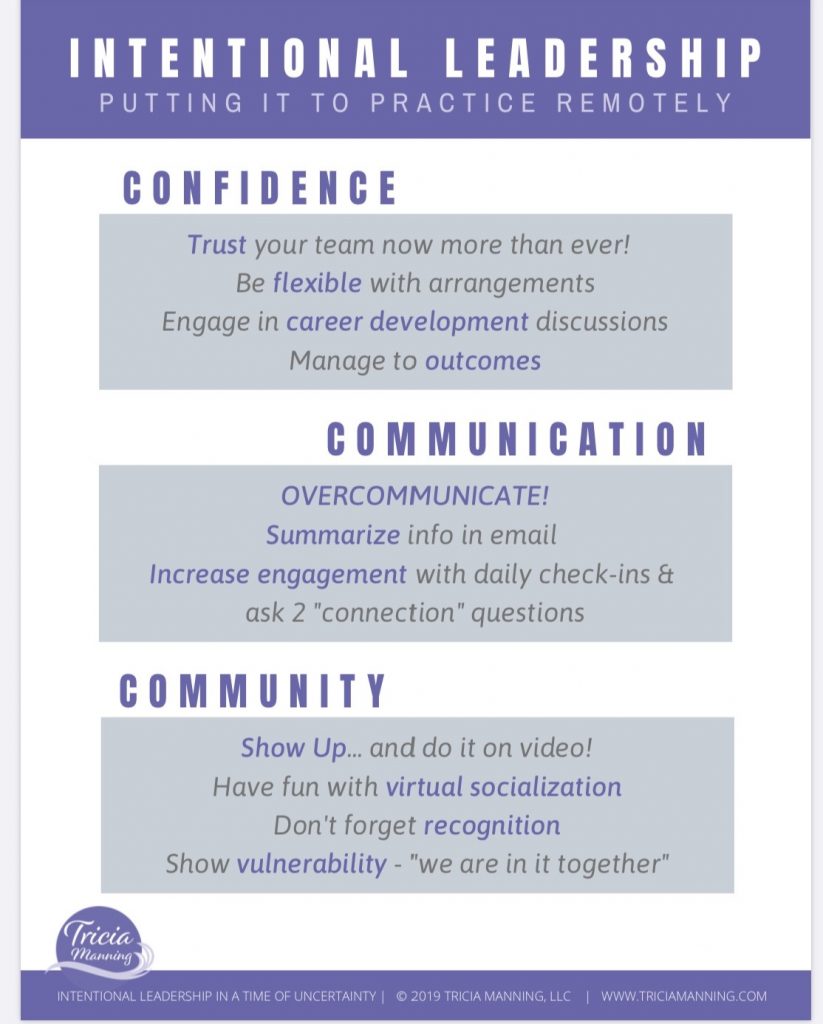
Think about how you are putting these strategies into practice with your teams. And for more details & examples around these strategies or help with additional ideas on to how to best support your teams, reach out to me directly. I would love to help.
Virtual HIGH FIVE to those front-line leaders who are committed to intentionally engaging the hearts and minds of their people, especially right now when it is needed most 💜

“What can I do to support you?”
It’s not a complicated question, but it is a question that defines excellent leaders and good leadership.
Your job is to keep your employees or team members engaged, motivated, and inspired to perform. As leaders, we are tasked with making time to grow and develop our teams – even when competing priorities loom overhead.
So what keeps leaders from asking their teams this question?
Chances are, you got where you are because you’re a high performer. You see a need and you fill it. You see a problem and you solve it. But when it comes to leading your team – you’re overfunctioning.
When your team doesn’t perform as expected, or makes a mistake, you swoop in to point out the error and tell them how to fix it. This results in a lack of confidence and self-doubt in your team, even if you end up with the results you wanted.
This behavior is well-intentioned. You want your employees to know they can count on you – that you’re not afraid to roll up your sleeves and do the work. But this overreaching behavior only stunts your team’s growth and leaves them feeling like you don’t believe they are capable of meeting your expectations.
At its core, the problem with overfunctioning is that the leader is focusing more on themselves and their needs than on their employees. When leaders fear that a task or project won’t be done correctly or quickly enough, they step in and just do it themselves.
This behavior is typically indicative that a leader is more focused on being right than on being a good leader.
How will an employee learn from a mistake or improve their skills in a new, unknown situation if their leader is constantly diving in and doing the work for them?
When you overstep as a leader, you’re showing your employee you don’t believe they are capable or resourceful enough to figure out the right answer or ask the right questions. When you’re consistently overfunctioning, your employees will internalize these beliefs – to the detriment of the employee and the company.
Instead of stifling your team’s growth, you can empower and motivate them by following a simple action plan.
This simple question shows them that you are on their side – you have their back – without shifting accountability or ownership for the results. You clearly expect them to achieve the outcome, but they know if they get stuck or have questions, they can come to you for support.
Instead of swooping in and “saving the day,” (while undermining your employee’s confidence and self-confidence) you motivate them to take action, show them you believe they can drive success and overcome adversity, and reinforce accountability.
According to Gallup, only the greatest leaders have the ability to create this kind of environment for their employees.
Following this simple process and making it a habit to ask, “What can I do to support you?” will help you escape the trap of doing it all as a leader and inspire your team to grow their confidence, develop their skills, and achieve excellence. Try stepping out, giving this system a try, and step up your leadership skills in the process.
To build your own leadership action plan and avoid overfunctioning in your workplace, schedule a call today.
Tricia is a global business leader, author, and leadership coach. Her unique corporate background gives her a clear understanding of the personal and professional challenges that senior business leaders face today. She brings real-life expertise around talent, culture, and leadership to every coaching engagement. Tricia is committed to helping individuals, teams and organizations accelerate performance.
Tricia believes this can be done with authenticity and staying true to personal values, beliefs, and leadership styles.
“I would like to be less productive”, said no one ever! Often, my coaching clients are faced with overwhelming demands to increase the speed of decision making & delivery and caught up in that always-on / always-connected feeling – trying to keep pace by doing more, multi-tasking, context switching. While not intended, this approach can actually cause them to be less productive in the end.
It is so important to be present and mindful about what we are adding to our plate – prioritization is critical to helping us stay focused on high-value activities (the critical few things!) that drive successful outcomes.
Even more than that, a prioritization mindset is what will help us achieve our personal and professional best! When adopted, a prioritization mindset will create the space and energy to focus on the things that really matter.

So what can you do to adopt a prioritization mindset and how do you know when you get there?
As a leader, you hold true to the vision for the organization, you set the agenda and you make the rules. You establish boundaries and hold your team accountable to certain standards of performance. But are you giving yourself permission to set boundaries that protect your own happiness at work?
Boundaries set the tone for the emotional climate of the organization and reflect the behaviors you will allow and the culture you desire. When you set boundaries, you are making space for your personal goals and your best work as your best self.
If saying no is difficult for you, you may be drowning in a sea of Yes’s. Your to-do list is long and filled with tasks that weren’t originally on your radar and aren’t in support of the goals you set for yourself.
Know what matters to YOU – ask yourself these questions… does this request align to strategy or delight a customer? Does it play to my strengths, develop a blind spot, provides an opportunity?
When you say No, you are saying Yes to those things that excite you, advance your development, move you toward your goal.
It is easier to develop a complex solution than a simple one. Simplicity is hard but when it comes into focus, it creates abundance – in energy, time, meaningful work, health. It enables you to move away from complex, chaotic choices and begin thinking about your work and life in a different way.
Be intentional in looking for the simple solution, start planning ahead, stop watching so much tv, spend less time on social media. When you embrace simplicity, you embrace possibilities and become even more focused, confident, and committed to your direction in your career and your life.
When you feel depleted, you have nothing to give. It is easy to fill your time with the needs and priorities of others and activities you “should” do. Often personal priorities, self-care, “you time”, falls to the bottom of the list. If you are kind to yourself and consider your own needs, you will be able to show up fully for those around you.
When you commit to self-care, you are able to engage and contribute graciously so everyone benefits.
If you are stressed out, overwhelmed, or overcommitted, try some of these strategies. Developing and sustaining a prioritization mindset is one of the best ways to achieve more. More time and more energy to focus on activities that will help you reach your goals and achieve your personal and professional best.
Consider a professional business coach to help you narrow your focus, energy, resource so you can dedicate more of yourself to the few things that are going to make the biggest difference in your life!
The wrong mindset might be the very thing holding you back from achieving your potential. It doesn’t matter what specific goals they set for themselves – career change, job shift, promotion, better work/life balance – we inevitably end up talking about mindset.
I see this time and time again with my clients.
It is only when we have a calm, clear, focused, intentional mind, that we do our best work. This is when amazing things happen!
This state – one of clarity and focus – is also known as a “performance mindset,” and a high-performance mindset is an essential tool in your leadership toolbox.
It determines how you think about and interprets situations. It determines your emotional reactions. It determines the decisions you make and the actions you take.
All crucial considerations and choices for any leadership role in this global, complex, urgent world today.
…The emerging leader is focused on increasing her confidence.
…The senior operations leader is focused on delegating to her team.
…The high-performing sales executive is focused on internal collaboration.
To be successful with any developmental strategies that improve these areas, the right mindset is required FIRST. Your mindset directly supports your ability to reframe your thinking and create new habits for success.
How are you showing up each day?
If you aren’t operating as your best self every day, then it is likely you are bringing beliefs and thoughts to the table that are not serving you and could actually be pushing you further away from the life you want.
So many high-achieving leaders charge forward. But the most successful leaders I coach, seek clarity first. Go slow, to go fast. When you slow down, you have time to assess the situation, gather additional inputs, and come up with an intentional plan of action, free from speedbumps and unintended consequences that take you off course. Slowing down will help you go further, faster.
Practice Positive Daily Habits:
One size does not fit all. Building and sustaining a high-performance mindset has to be authentic to you and it should be reflective of the way you naturally approach the world. The practices, patterns, and approaches will look different for everyone but they generate the same outcome – increased confidence, a sense of calm, and most importantly, awareness of your emotions and behaviors. Positive daily habits like – affirmations, gratitude, physical exercise, meditation – start to automatically produce thoughts and beliefs that are productive.
Why is it important for you to do well? Define your greater purpose – that reason beyond yourself that you connect to and that motivates you to show up as your best self. Harnessing this motivation will help you be mentally tough and give you the energy and resilience you need when things get hard.
Start small and build from there. Committing to new habits and nurturing a calm, clear, focused, intentional mindset will be a differentiator in your success.
Why do real pros need an executive coach? I was talking to one of my executive clients recently about a female leader on his team. After approaching her about working with a coach, she wasn’t quite sure how to take his recommendation. But to him, a successful executive who had experienced the benefits of coaching firsthand (and also an avid golfer!), it made perfect sense.
He isn’t the first to use a sports analogy when it comes to leadership coaching.
The Masters is one of the most prestigious demonstrations of mental and physical strength in the world and my client knows that the right coaching relationship is what his team member needs to be ready to compete. Whether you are a sports fan or not, it is not that hard to draw parallels between elite sports athletes and the elite athletes in the boardroom.
Building on the analogy further…
To the world’s top golfers, a trusted coach is invaluable. Expectations are high and their performance is played out on the television every weekend. The coach is their motivator, accountability partner, sometimes consultant, and often advisor on the fickle game of golf. Likewise, Executive Pros need a coach for continuously improving performance.
Just like high-performing athletes, high-performing business leaders can also benefit from having a coach. This is especially the case today as leaders face volatile and uncertain times and are relied upon by their teams and organizations to tackle problems no one ever anticipated.
More and more CEOs, entrepreneurs, business owners, and managers are hiring executive coaches, not just for advice on business strategy, but to develop new skills – like interpersonal relationships, authentic leadership, listening, and empathy. Leaders can no longer rely solely on proven gameplay to drive results and achieve success today.
They must continue to up their game…question the status quo and be effectively challenged to go beyond what they have always done and what they even think is possible.
We have heard the saying – “a bad attitude is worse than a bad swing” – so no surprise that the best golfers use their coaching sessions to improve their swing and mental fitness most.
The pros on the course maximize their chance of success by placing the ball in the right position, knowing the course, and focusing on the skills that prepare them best for the winning shot.
Similarly, the pros in business are intentional in their personal development and in improving their skills – like the ones above –so they can take their leadership game to the next level.
Whether you are preparing to compete in The Masters or the US Women’s Open, men’s and women’s leadership development is enhanced greatly with the support of a coach.
If you are looking to improve your personal and professional performance, job satisfaction and ultimately, increase the effectiveness of your team and the outcomes of your organization, then you are a pro, and a trusted and valued coach is for you.
